More than 140 University of Michigan students and Ann Arbor community members gathered at the Michigan Theater Sunday afternoon for the viewing of “A Savage Art: The Life & Cartoons of Pat Oliphant,” a documentary detailing the life of Pulitzer Prize-winning political cartoonist Patrick Oliphant. The documentary was followed by a panel discussion hosted by the Wallace House Center for Journalists about modern-day media control and the role of editorial cartoons in questioning authority.
The documentary centered on Oliphant’s life and the impact of his career as an editorial cartoonist spanning over half a century. It specifically focused on the long-standing history of using humor in political cartoons to question those in power, including the renewed importance of political cartoonists in today’s era of political polarization and the centralization of media control.
Beginning in 1990, Oliphant made annual visits to the University to give lectures to Knight-Wallace Fellows, and many of his original works hang in the Wallace House Center for Journalists today.
In an interview with The Michigan Daily, Law School student Clint Keaveny said Oliphant’s cartoons gave him perspective on how political cartoons have impacted political discourse over time.
“It was interesting to see that people have had the same reactions and indignation and emotion about a lot of similar topics for a long time,” Keaveny said. It kind of gave me a sense of the continuity of outrage in American politics.”
In an interview with The Daily, Law School student Jem Ruf, who attended the screening, said while he was unfamiliar with Oliphant’s work, his view of cartoons changed after watching the documentary.
“We don’t, obviously, have as much exposure to print media anymore, so I thought it was really cool,” Ruf stated. “I didn’t really understand how much artistry went into his work, so I was really blown away by some of the quality. … I kind of considered cartoons more like the Charlie Brown style, where they’re not as lush and not as interesting visually.”
Immediately following the film screening, director Bill Banowsky; Charles Eisendrath, journalist and former Knight-Wallace Fellowships director; and Mike Thompson, four-time Pulitzer Prize Finalist for Editorial Cartooning, discussed Oliphant and his legacy. The panel was moderated by Wallace House director Lynette Clementson.
Banowsky said the project began as a series of five-minute portraits of interesting people in Santa Fe, N.M., but became an 87-minute-long documentary after Banowsky met Oliphant and was inspired by the depth of his work.
“I had no idea about the importance or the history of political cartooning, and I had no idea that when we finished this film, that we’d be in such a moment … where editorial cartooning is really almost — not a dying art, (but) it’s very close to a dead art because newspapers just simply won’t put these things out,” Banowsky said.
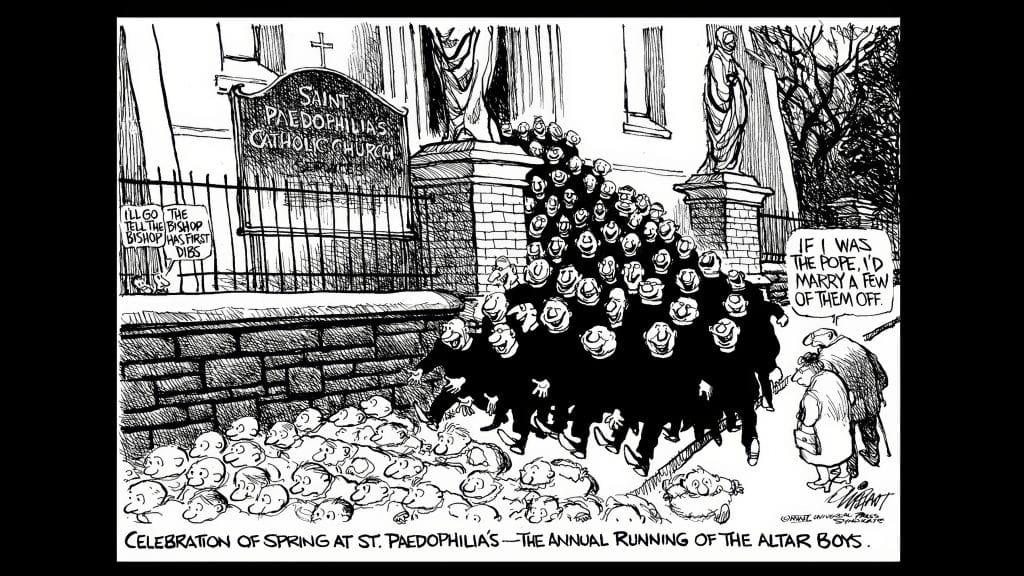
Banowsky said he and his team attempted to run three ads for the event, each including an image of one of Oliphant’s political cartoons, on The Daily’s Instagram story as a sponsored post. Only two were run, the first including Oliphant’s 2002 cartoon “The Annual Running of the Altar Boys,” about pedophilia in the Catholic church following a string of scandals, and the second including an unnamed cartoon depicting Alice from “Alice’s Adventures in Wonderland” being asked to pick between two identical figures wearing “Republican” and “Democrat” shirts.
The third ad, which was not run by The Daily, contained an unnamed cartoon depicting a Star of David with sharp teeth being wheeled in militaristic pursuit after a small woman labeled “Gaza.” The cartoon has been denounced by various Jewish groups as antisemitic.
Banowsky said he felt that many people are not receptive to satire cartoons because they’re afraid of inciting anger from current political leaders.
“I think it’s important for people who are my son’s generation — who haven’t grown up with satire — to be able to see the history of satire, and the importance of satire, and (have) the ability to poke fun at our leaders,” Banowsky said. “That is gone, and that’s the real threat to a free society.”
Adam Zyglis, Pulitzer Prize-winning cartoonist who was featured in the documentary, faced death threats this past summer after his cartoon depicting a man wearing a MAGA hat submerged in the Texas Floods and holding up a sign that said “Help,” was critiqued in an official statement from the White House.
Banowsky said other cartoonists have been driven out of mainstream media due to backlash, including Ann Telnaes, who resigned from The Washington Post because The Post refused to run a cartoon depicting billionaires currying favor with President Donald Trump, or Rob Rogers, who, according to himself, was “fired for making fun of Trump.” According to Banowsky, many cartoonists have taken to alternative publishing like Patreon or Substack.
Panelists linked the discussion to a broader debate over the role that memes play in political critique. Ultimately, while memes often critique those in power in the same way that editorial cartoons do, those on the panel believed that memes lacked the same impact.
“I think memes are akin to gag cartoons,” Thompson said. “Political cartoons, ultimately, you’re trying to say your opinion or express a point of view … whereas a meme, they’re funny, yes, a lot of them, but there’s no larger opinion being discussed. I don’t agree with the notion that political cartoons have been supplanted by memes.”
In an interview with The Daily, Law School student Robert Julien said cartoons were a vital medium for questioning authority.
“I think that we’re at a time where there aren’t enough people who are fearless enough to kind of ‘stir the beast’ in the way that (Oliphant) did,” Julien said. “Hopefully, this film will inspire more people to be comfortable and willing to take that risk.”
Daily Staff Contributor Rebecca Borlace can be reached at rborlace@umich.edu.